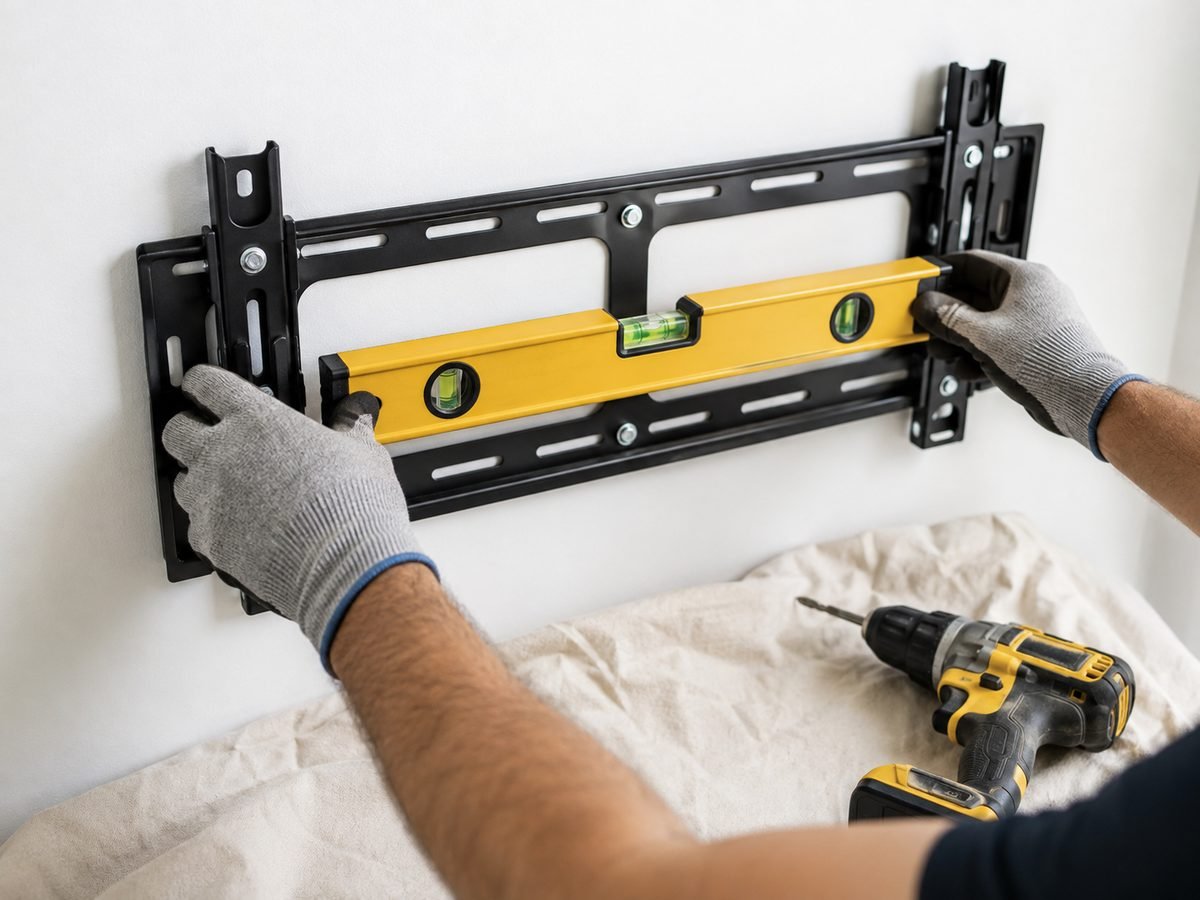
TV wall mount installation, done the way the trade does it

Which bracket actually suits your room, what VESA means, what each wall type demands, and what the job honestly costs - from installers who mount TVs every day, not a content writer who never has.

  • Bracket matched to screen and wall
  • Fixings into framing, never sheet alone
  • 5-year workmanship warranty

Step one

Three bracket types, and the room decides

Most people buy the bracket first and regret it. The right order is room, then wall, then bracket - because the bracket that suits a straight-on lounge room is the wrong one above a fireplace or in a corner.

Fixed (low-profile)

Sits 10 to 30 mm off the wall - the cleanest look by far. Right when you always watch from the same seats, straight on, with the screen at eye level. No adjustment after installation, so the set-out has to be exact. It is also the cheapest bracket and puts the least load on the wall.

Tilting

Angles the screen downward, typically 5 to 15 degrees. Earns its money whenever the screen must go higher than eye level - above a fireplace, a bedroom wall, a cafe or waiting room. Costs a little more depth off the wall and a little more money.

Full-motion (articulating)

Extends, swivels and tilts on an arm. The only real answer for a corner position, a room watched from two directions, or a screen that must pull out over a cabinet. The trade-off: the extended arm multiplies the load on the fixings several times over, so the wall type and fixing quality matter far more than for a flat mount.

Quick chooser
Your situationBracketWhy
Lounge room, straight-on viewingFixedCleanest look, lowest cost, least wall load
Above a fireplace or high on a bedroom wallTiltingBrings the picture back down to the viewer
Corner position, or watched from kitchen and loungeFull-motionThe only type that aims the screen where you are
Samsung The Frame or an art-style TVSlim-fitPurpose-made bracket keeps it flush like a picture

VESA in one paragraph

VESA is simply the rectangle of four threaded holes on the back of your TV, measured in millimetres - 200×200, 400×400, 600×400 and 800×400 cover almost every screen sold in Australia. The bracket must match or exceed your TV’s pattern and its weight rating. You will find the pattern in the manual, on the spec page, or by measuring hole-centre to hole-centre.

Weight ratings are not a suggestion

A modern 65-inch screen weighs 20 to 25 kg; an older plasma can be double that. Brackets are rated with a safety margin, but that margin assumes the fixings hold - a 60 kg-rated arm on a single steel stud is rated for nothing. This is why we treat the wall, not the bracket, as the real load question.

Supply it, or bring your own

We carry fixed, tilting, full-motion and slim-fit brackets in the van, quoted at hardware cost plus fitting. If you have already bought one, we fit it at no penalty - we just check the VESA pattern and weight rating first, and we will tell you honestly if what you bought does not suit the wall or the screen.

Either way the bracket is levelled with an actual level, the screen locked to it, and the anti-lift tabs engaged - the details a rushed install skips.

Mounting a TV on a wall

The six things a proper install always does

Whether you hire us or do it yourself, this is the sequence that keeps screens on walls. Where DIY goes wrong is almost never the drilling - it is skipping one of these.

  1. Identify the wall first

    Gyprock over timber stud, steel stud, brick veneer, double brick, Hebel, VJ boards or concrete - each takes a different fixing. If you are not certain which you have, that is the moment to stop.

  2. Find the framing, not just a spot

    On stud walls the bracket must land across at least two studs at 450 or 600 mm centres. A stud finder gets you close; a small test hole behind where the TV will sit confirms it.

  3. Scan before you drill

    Power runs vertically above and below outlets and horizontally between them. Water and gas do not follow rules at all. A services scan costs minutes; hitting a cable costs a great deal more.

  4. Set the height seated

    Screen centre at seated eye level - roughly 1,000 to 1,100 mm off the floor for a lounge. Mark it, sit down, look at the mark. Adjust now, not after the holes exist.

  5. Fix to the rating, not to “feels solid”

    Coach screws into timber, toggles rated for steel stud, sleeve anchors into brick faces (never mortar), AAC-specific fixings in Hebel. Torque them; do not strip them.

  6. Lock, level, test

    Screen locked onto the bracket, anti-lift tabs engaged, levelled on the wall, every source tested. Then - and only then - the cables get concealed.

Honest DIY guidance: a fixed bracket, a confirmed timber-stud wall and a screen under 55 inches is a reasonable weekend job for someone who owns a stud finder and a level. A full-motion arm, any masonry or Hebel wall, a screen over 65 inches (a two-person lift), or in-wall cabling is where paying a professional is cheaper than the mistake. That is not a sales line - it is triage we repeat on the phone every week, sometimes by talking people out of booking us.

The wall decides the job

The wall matters more than the bracket

Every mounting failure we get called to repair traces back to the wall, not the bracket: hollow-wall anchors in plasterboard alone, a full-motion arm on one stud, anchors in mortar joints, or standard plugs crumbling out of Hebel.

Queensland adds its own wall types to the usual list - Hebel panel in the new estates, VJ tongue-and-groove in Queenslanders, besser block in townhouses - and each one changes the fixings, the time and sometimes the bracket choice.

Every Brisbane wall type, explained →

An installer checking a wall with a stud finder before drilling
Wall identified, framing found, services scanned - before the drill comes out.

What it costs

Real numbers, not “request a quote”

Professional TV mounting in Brisbane runs from about $150 for a standard fixed mount on a stud wall, up to around $360 for a very large screen on a full-motion arm with two installers. In-wall cable concealment adds $90 to $150; harder wall types add $50 to $100. For market context: Airtasker publishes a Brisbane median of $175, and premium installers publish $299.

The full table - by screen size, bracket type and add-on - is published on our Brisbane TV wall mounting page, and the price you are quoted is fixed before work starts.

The result

What a finished install should look like

A television on a low console with power and antenna leads visible behind it Before

Before

Screen on a console, leads visible, sitting too low for the room.

The same room with the television mounted level on the wall and no visible cables After

After

Bracket across two studs, screen at seated eye level, leads inside the wall between brush plates.

Bracket and install questions

Asked before every booking

Brisbane-specific questions - height, fireplaces, apartments, timing - are answered on the Brisbane mounting page.

Not sure which bracket or wall you have? Send a photo of the room and the TV model and we will tell you.

Call 07 XXXX XXXX
What VESA size do I need?

Check the manual or spec page for your model, or measure the distance between the threaded holes on the back of the TV, centre to centre, in millimetres. Common patterns: 200×200 on small screens, 400×400 on most 55 to 65 inch models, 600×400 and 800×400 on large screens. The bracket box lists the patterns it accepts - your TV’s pattern must be on that list, and the bracket’s weight rating must exceed the TV’s weight.

Can I mount a TV without drilling holes?

For a real television, honestly, no. Adhesive and tension-pole products exist, but nothing adhesive is rated for a 15 to 25 kg screen on a wall in a home with children walking past it, and we will not fit one. The rental-friendly answers that actually work are a quality floor stand with a mounting column, or written lessor approval for a proper fixing - in Queensland that is the RTA Form 23 route, and holes in gyprock patch invisibly at the end of a tenancy.

Which bracket works in a corner?

Only a full-motion arm. The bracket fixes to one of the two walls, the arm articulates the screen across the corner, and the screen aims into the room. Two things matter more than usual: the arm’s extension has to reach far enough for the screen to clear both walls at the angle you want, and the wall it fixes to carries the whole cantilevered load - so this is the one install where we are fussiest about the fixings.

Do OLED and Samsung The Frame TVs need special brackets?

OLEDs are thinner and lighter than LED screens of the same size but use standard VESA patterns - any quality bracket fits, and a fixed low-profile bracket shows them off best. Samsung The Frame is the exception: it ships with (or offers) a dedicated slim-fit bracket that recesses the screen flush like a picture frame, and using a generic bracket defeats the whole point of that TV. We fit both kinds weekly.

Can I reuse my old bracket for a new TV?

Sometimes. Check three things: the new TV’s VESA pattern is one the bracket accepts, the new screen’s weight is under the bracket’s rating, and the bracket is not damaged or missing its locking hardware. Where it passes all three we re-use it happily and the job costs less. Where it fails any one, the bracket is the cheapest component in the system - replace it rather than gamble the most expensive one on it.

Does the soundbar go on the same bracket?

Usually on its own small bracket directly below the screen, or on a soundbar adaptor that hangs off the TV bracket itself - which one depends on the soundbar’s weight and the TV bracket’s design. Either way it should sit centred to the screen, gapped so neither blocks the other, with its lead in the same concealed run. Mounted in the same visit it adds about $60.

Get a price

Tell us the room, we will name the number

Suburb, screen size and wall type gets you a fixed price on the phone. Brisbane and all of South East Queensland.

07 XXXX XXXX

  • Monday to Friday[trading hours]
  • Saturday[trading hours]
  • Sunday[trading hours]
  • Service areaBrisbane and South East Queensland

Request a free mounting quote

Not sure? Leave it on the first option and we will ask for a photo instead.

We use your details to quote this job and nothing else. Prefer to talk? Call 07 XXXX XXXX.