Starlink roof mounts: which one your roof actually needs

Starlink’s kit arrives with a kickstand and nothing else. Every official mount explained - Pivot, Flashing, Ridgeline, Pipe Adapter, wall and ground pole - matched to Australian roofs, including the tile rule most installers ignore.

  • Official mount names and constraints
  • Tile, Colorbond, tin and flat roofs
  • Honest DIY-or-installer advice

The short version

Thirty seconds, then the detail

Colorbond or metal roof: Pivot Mount with proper flashing - the standard, straightforward install. Tile, slate or clay roof: not the Pivot Mount - Starlink itself does not recommend it there. Use a ballasted Ridgeline Mount, a bracket fixed to the battens under the tiles, or a mast. Already have a TV antenna mast? The Pipe Adapter fits metal pipe from 31 to 63.5 mm and reuses it with no new holes in the roof. Trees over the house? A taller mast, or a Ground Pole Mount out in the clear. Flat roof or deck: the Ridgeline Mount, ballasted, no drilling at all.

The official line-up

Six mounts, one job each

These are Starlink’s own mounts with their published constraints. Aftermarket brackets exist and some are good, but every one of these has an install guide from Starlink itself, which matters when the warranty question comes up.

Pivot Mount

The default for slanted metal roofs: a hinged foot that bolts through the roof into structure and lets the dish sit plumb on any pitch. Requires drilling and proper sealing. The one everyone buys - and the one Starlink says not to use on tile, slate or clay.

Flashing Mount

Not a mount on its own - a waterproofing base used together with a Pivot Mount on shingled and metal roofs. It manages water the way roofing is supposed to: shedding over a flashed plate rather than trusting a bead of sealant for ten years.

Ridgeline Mount

The clever one: sits over the roof ridgeline or on any flat surface, held down by ballast weights, no drilling at all. This is the tile-roof and rental-friendly answer, and the flat-roof answer, in one product. Its limit is exposure - on a cyclonic-wind site we check ballast and position carefully.

Pipe Adapter

Clamps the dish to any existing metal pole, mast or J-mount from 31 to 63.5 mm in diameter. If your house has a sound TV antenna mast, this is usually the best install available: highest point on the roof, zero new penetrations, and the old antenna can often stay too. Metal pipe only - never PVC.

Short & Long Wall Mounts

Fix the dish to a wall or fascia, clearing eaves and overhangs up to 2 inches (Short) or 12 inches (Long). Right where the northern sky is open off a gable end, or where the roof itself is off-limits. Requires drilling into masonry or framing - not into fibro sheet.

Ground Pole Mount

A pole set in the ground, up to 50 inches of clearance, out where the sky is open. The answer when trees crowd the house: the dish goes to the clear part of the yard and the cable comes back in a trenched conduit. More work, but it fixes obstruction problems nothing on the roof can.

Mount names, intended surfaces and constraints from Starlink’s official installation guidance, verified 20 August 2026. The Standard Kit itself ships with a kickstand only - every roof or pole option is a separate purchase.

Roof by roof

Match the mount to the roof, not the other way around

Australian roofs and the right Starlink mount
Your roofRight mountWhy
Colorbond / metal deck Pivot Mount + flashing Screws land in structure through the sheet; flashing manages water properly
Concrete or terracotta tile Ridgeline, or batten-fixed bracket Starlink advises against the Pivot Mount here - tiles crack under point loads and drilled tiles leak
Older corrugated tin Pivot Mount, after an inspection Rusted sheet and tired battens first; fixings must reach sound timber
Flat roof, deck or carport Ridgeline Mount, ballasted No penetrations on a flat surface that ponds water - ballast does the holding
Pre-1990 fibro / asbestos-era roof Nothing drilled - Ridgeline, wall, mast or ground pole Drilling asbestos sheet is a health hazard and in many cases unlawful without licensed handling. We do not drill it, full stop
Existing antenna mast Pipe Adapter 31-63.5 mm metal pipe; the highest point, no new holes
Heavy tree cover Taller mast or Ground Pole Mount Height or distance - the obstruction scan decides which

The asbestos row matters in Brisbane: a large share of pre-1990 homes carry fibro roofing or eaves. If your house is that era and you are not certain, treat it as asbestos until tested.

The tile problem, properly

Why the standard mount and a tile roof do not mix

A roof tile is strong in the way it was designed to be loaded - spread across its bed, shedding water downhill. It is weak in exactly the two ways a bolted mount loads it: point pressure, which cracks the tile now or after a summer of expansion cycles, and penetration, which turns a shed-water surface into a hold-water hole. Sealant hides that hole for a year or three; Queensland storms find it eventually.

That is why Starlink’s own guidance excludes tile, slate and clay from the Pivot Mount - and why a suspiciously cheap tile-roof quote usually means someone plans to bolt it on anyway.

The compliant options, in the order we reach for them:

  • Ridgeline Mount - ballasted over the ridge, touching nothing that keeps water out
  • Batten-fixed bracket - load carried by the battens and rafters under the tiles, with the tile dressed back over the bracket leg
  • Mast or wall mount off a structural point - including the Pipe Adapter on an existing antenna mast
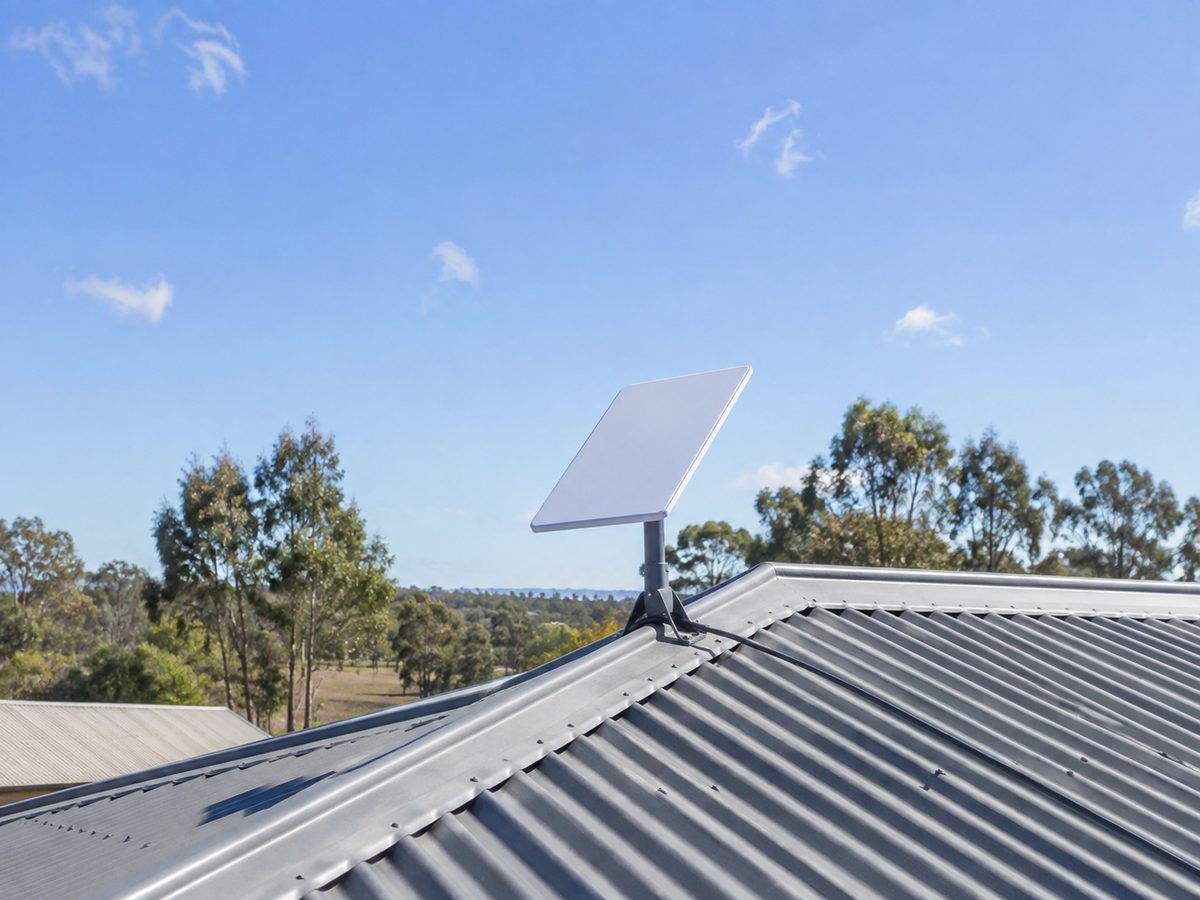
A Starlink dish mounted on a roof
The mount decision is a roofing decision first and an internet decision second.

Straight answer

DIY it, or book someone?

Some of these installs are genuinely a weekend job. Some only look like one from the ground. The honest split:

Where DIY makes sense
SituationVerdictWhy
Kickstand on the ground or a deck DIY That is what it ships with - test the service this way first
Ridgeline on an accessible single-storey roof DIY, with care No drilling, but ballast is heavy and roofs are roofs - two people minimum
Pivot Mount on metal, single storey Capable DIY Drilling into structure and sealing properly - fine if you have done roof work before
Anything on tile Installer Batten fixing and tile dressing is roofing work; broken tiles cost more than the install
Two storey, steep pitch, or asbestos era Installer Fall risk and licensed-handling rules are not weekend material
Ground pole with trenched cable Installer Dial-before-you-dig, conduit depth and a concrete footing done once

In Brisbane or South East Queensland? We install every option on this page - obstruction test first, mount matched to the roof, quoted before we start. Typical installs run $299 to $399 on metal roofs, more on tile and complex sites. See the Starlink installation service →

Budgeting it

What the hardware and the install cost

Mount hardware from Starlink’s shop runs from roughly $50 to $120 for the Pivot Mount and Pipe Adapter class of hardware, to around $150 to $250 for the Ridgeline and wall-mount options - check starlink.com for current AUD pricing, as it moves. Aftermarket tile-bracket systems and masts are priced by the job.

Professional installation in Brisbane typically lands between $299 and $399 for a single-storey metal roof with a short cable run, with tile roofs, two-storey access, long runs and ground poles quoted above that - always before work starts. The full breakdown lives on the installation service page, alongside our published TV mounting prices, because publishing numbers is how we prefer to operate.

Mount questions

The ones the manuals skip

Install-service questions - kit purchase, timing, whole-home Wi-Fi, storms - are answered on the Starlink installation page.

Send a photo of your roof and we will name the right mount before you buy anything.

Call 07 XXXX XXXX
Does the Starlink kit come with a roof mount?

No - this catches almost everyone. The Standard Kit ships with a kickstand for ground or deck placement and nothing else. Every roof, wall, pole and ridgeline option is a separate purchase from Starlink’s shop or an aftermarket supplier. If your sky is clear from the backyard, the kickstand alone is a legitimate permanent setup; most houses need height, which means buying a mount.

Can I just leave the dish on the kickstand on the ground?

If the obstruction scan is clean from that spot - yes, genuinely. It is the cheapest install there is and we recommend it when it works. The catches: mowing and pets, cable across the yard, and the fact that ground level usually sees more tree and fence than sky. Run the app’s obstruction test at ground level first; if it shows interruptions, height is the fix and a mount enters the picture.

Can I mount Starlink on my fence or pergola?

Structurally, often yes - a wall mount on a solid post or a Pipe Adapter on a steel pergola upright works. The real question is sky: fences and pergolas are low, and low positions catch obstructions. If the scan is clean there, it is a tidy low-cost install. A timber fence in poor condition is the exception - the dish outlives the fence, and the wind load works the palings loose.

How high does the dish actually need to be?

There is no magic height - only a clear view. The dish needs open sky from roughly 20 to 25 degrees above the horizon up to overhead, mostly toward the north in Australia. Height helps only because it lifts the dish over whatever blocks that view. A single-storey roof in an open estate is usually plenty; under mature gums, even a two-storey roof can lose to a 25-metre tree, which is when a ground pole in the clear beats any roof mount.

Do the mounts fit both the older rectangular dish and the current one?

Mostly yes, with an asterisk. Current mounts are built for the current Standard dish; the older rectangular “Gen 2” dish shares the same pipe-style fitting for most options, and Starlink sells an adapter where generations differ. If you are buying second-hand hardware, match the mount to your dish generation before paying - and if in doubt, send us the model and we will check it against what is current.

Will a ballasted Ridgeline Mount survive Queensland storms?

Fitted with the specified ballast, positioned per the guide, yes - ballasted mounts are engineered for real wind, and the dish itself stows flat in extreme gusts. What undoes them is under-ballasting (“it felt heavy enough”) and placement on a slick, steep section instead of the ridge. In cyclone-rated coastal zones we lean toward fixed options bolted to structure instead, and we will say so when your address calls for it.

Skip the guesswork

Photo of the roof, mount named, price fixed

We install every mount on this page across Brisbane and South East Queensland - and we will tell you if the kickstand is all you need.

07 XXXX XXXX

  • Monday to Friday[trading hours]
  • Saturday[trading hours]
  • Sunday[trading hours]
  • Service areaBrisbane and South East Queensland

Request a free Starlink quote

Not sure? Leave it on the first option and we will ask for a photo instead.

We use your details to quote this job and nothing else. Prefer to talk? Call 07 XXXX XXXX.